What 7v7 actually is, and why skill-position kids develop faster in it
Parents hear 7v7 and picture a lesser version of real football. For a skill-position athlete it is closer to concentrated practice at game speed.
September 21, 2026 · 3 min read
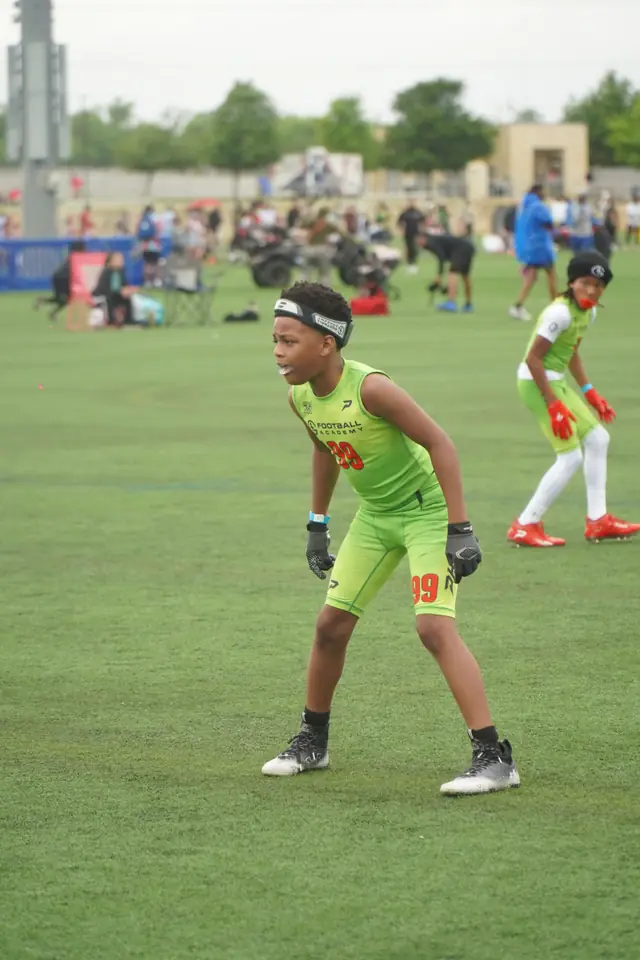
If your child plays receiver, running back, linebacker, defensive back or quarterback, 7v7 is probably the most useful football they can be playing, and it is the format most parents understand least.
The format, plainly
7v7 is football with the line play taken out. No offensive or defensive line, no tackling, usually a shorter field. What is left on the grass is quarterbacks, receivers, running backs, linebackers and defensive backs, doing the thing they get evaluated on, repeatedly, at full speed.
G1 Football Academy runs its 7v7 national team in four divisions: 8U, 10U, 13U and 16U. The team competes in major tournaments across Texas and in select tournaments in Florida.
The development case is arithmetic
In a full-contact youth game, a receiver might have the ball thrown their way a handful of times across four quarters. Much of the rest of the game is blocking, standing on the sideline, or running plays designed for somebody else.
In a 7v7 tournament weekend the same athlete runs routes against live coverage all day. Not drills against a cone. Actual coverage, from a defender trying to stop them, over and over.
That is the whole argument. Reps are how technique turns into reflex, and reflex is what holds up when a game gets fast. This format buys an athlete several times the meaningful repetitions for the same amount of weekend, which is why skill-position players who play 7v7 tend to pull away from those who only play a contact season.
It exposes things a contact game hides
There is a second, less obvious benefit. Contact football is generous to athletes with one dominant trait. A very fast child can outrun a bad route. A very big child can bully their way through a technique problem. Take the line away and put an athlete in space against a defender who is also fast, and the technique problem becomes visible immediately.
That is uncomfortable for a weekend and valuable for a career. A twelve-year-old who discovers in 7v7 that they cannot beat a defensive back off the line has just been handed the exact thing to work on. The same child in a contact season might go a whole year without finding out.
What each division is really doing
The four divisions are not one activity at different heights. An 8U roster is learning to play a position at all: line up here, this is your job, this is how you get off the line. Whether the team wins matters much less than whether a child can execute one assignment without being told twice.
By 13U athletes are running real route trees against defenders who can read them, and coaching shifts from what to do toward how to beat the person in front of you. At 16U the purpose changes again, because these athletes are inside the window where college programs genuinely look, and the calendar starts functioning as part of a recruiting plan rather than just a season.
The safety answer
There is no tackling in 7v7. For a family who wants their child challenged competitively but is not ready for contact, that makes it the honest recommendation rather than a compromise. It is also the sensible route for an athlete coming back from an injury who should not be taking hits yet, and for a child who wants to try competitive football without committing to pads.
What it asks of you
Be realistic about the travel. Tournaments across Texas plus select Florida events mean real weekends away, and it is worth asking to see the season schedule before you commit rather than after. Costs depend on the division and the season, so the number you want is the one for your athlete's group.
On recruiting, be careful with anyone who promises outcomes. Showcase events and national tournaments put an athlete in front of people who evaluate athletes, and that is how exposure genuinely works at this level. Nobody can promise a scholarship, and a program that implies otherwise is telling you something about itself.
What a program can do is make sure your child is prepared, seen, and not carrying an avoidable technique flaw when they are. At G1 the 7v7 offense is run by offensive coordinator Lawann Latson, whose fifteen-plus years of player development include athletes who reached the NFL, among them Tank Dell, KaVontae Turpin and Trent Taylor. To ask which division suits your athlete, call (972) 269-5188.
G1 Football Academy, (972) 269-5188
Call (972) 269-5188More articles
Flag or tackle: how to tell when your child is ready for contact
The question underneath almost every first phone call to a youth football program is whether it is going to hurt their child. Here is the honest way to think about it.
How to judge a youth football coach, and what to ignore
You are not really choosing a program. You are choosing the adults who will spend two afternoons a week shaping how your child handles being corrected.