40 · League teams
Kindergarten flag, then tackle when the age is right.
Four teams on a deliberate ladder: Kindergarten flag, 1st grade flag, 3rd grade tackle and 4th grade tackle.
Chapter 01
Flag first, and why the ladder is built that way
The four league teams are Kindergarten flag, 1st grade flag, 3rd grade tackle and 4th grade tackle. Read in order, that is two full years of flag before a child is asked to take or give contact. It is the single most important thing on this page for a parent of a five or six-year-old, because the question underneath almost every first enquiry is whether football is going to hurt their child.
Flag is where the actual game gets taught. A child learns where to line up, what their assignment is, how to read the person across from them and how to run a route or cover one, without any of that competing for attention with the fear of being hit. By the time an athlete reaches 3rd grade tackle they already know the game, so the new thing they are learning is contact on its own rather than contact plus everything else at once.
There is no flag team at 2nd grade in the published ladder and no tackle below 3rd grade. That gap is the point rather than an omission: a child finishing 1st grade flag has a year to grow before tackle is on the table.
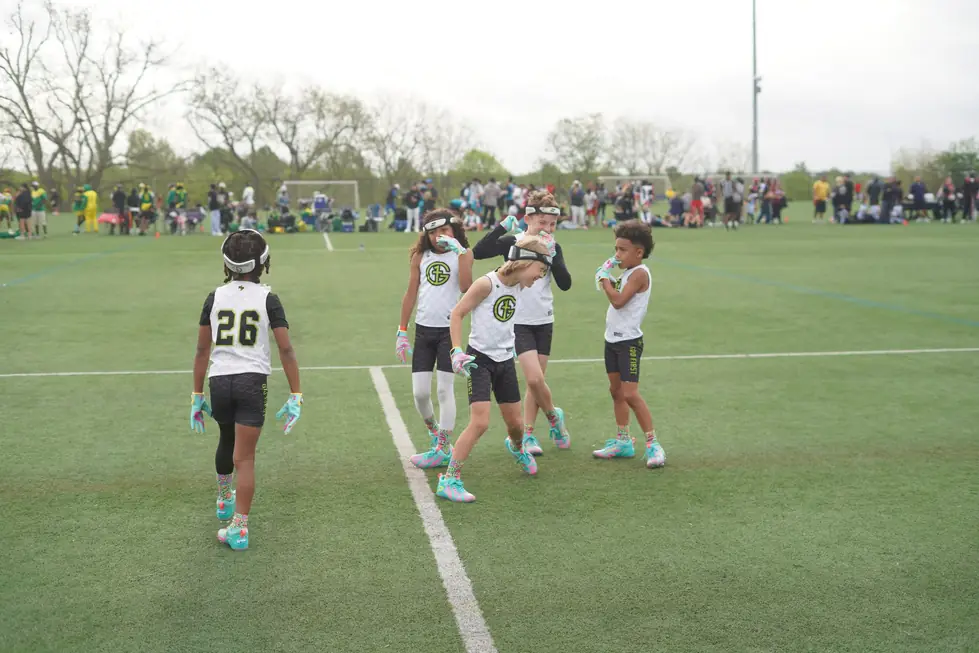
Young G1 Football Academy athletes in white team pinnies on the field at a tournament
What a first season asks of a family
A first-year flag parent should expect practice plus a game week, kit that carries the G1 crest and the GOD FIRST wordmark across the chest, and a coaching staff who will talk to you rather than through you. The academy's own line is that it supports parents so no player gets lost in the system, and in practice that means you should be able to get an answer about your own child from someone who coaches them.
Costs for league teams depend on the season and the division, so the academy gives you the figure for your athlete's group rather than publishing one number that would be wrong for four different teams. Call (972) 269-5188 or send a message with your child's grade and the staff will tell you what the season costs and when it starts. Where cost is genuinely the obstacle, ask about the scholarship and mentorship support, because the academy states plainly that cost should never be the barrier.
Specific practice and game locations go out to enrolled families directly and through the family portal rather than being published, so the academy will tell you exactly where to be once your athlete is placed.
Chapter 03
The move to tackle at 3rd grade, and what changes
The honest answer about the jump from flag to tackle is that the football barely changes and the physical demand does. Assignments, formations and reads carry over almost intact. What is new is pad fit, tackling and being tackled, and the conditioning that contact costs. That is exactly why it sits at 3rd grade rather than at five years old, and why two years of flag come first.
It is also the moment where having former professional players on the staff stops being a marketing line. Teaching a nine-year-old to tackle safely is a technique problem with real consequences, and the people teaching it here played the game at a level where bad technique ended careers. Ramon Broadway captained Arkansas and played in the NFL and the CFL. Ron Brooks played cornerback for the Buffalo Bills and the Philadelphia Eagles. They are coaching the contact, not supervising it.
Not every athlete should move up on schedule, and the staff will say so. If a child finishing flag is not ready for 3rd grade tackle, the useful options are another flag year, position training to hold technique, or the 7v7 national team, which is competitive football with no tackling in it at all. Ask the question directly and you will get a direct answer.
G1 Football Academy, Dallas, Texas. Flag from Kindergarten, tackle from 3rd grade. Call (972) 269-5188.