Flag or tackle: how to tell when your child is ready for contact
The question underneath almost every first phone call to a youth football program is whether it is going to hurt their child. Here is the honest way to think about it.
September 21, 2026 · 4 min read
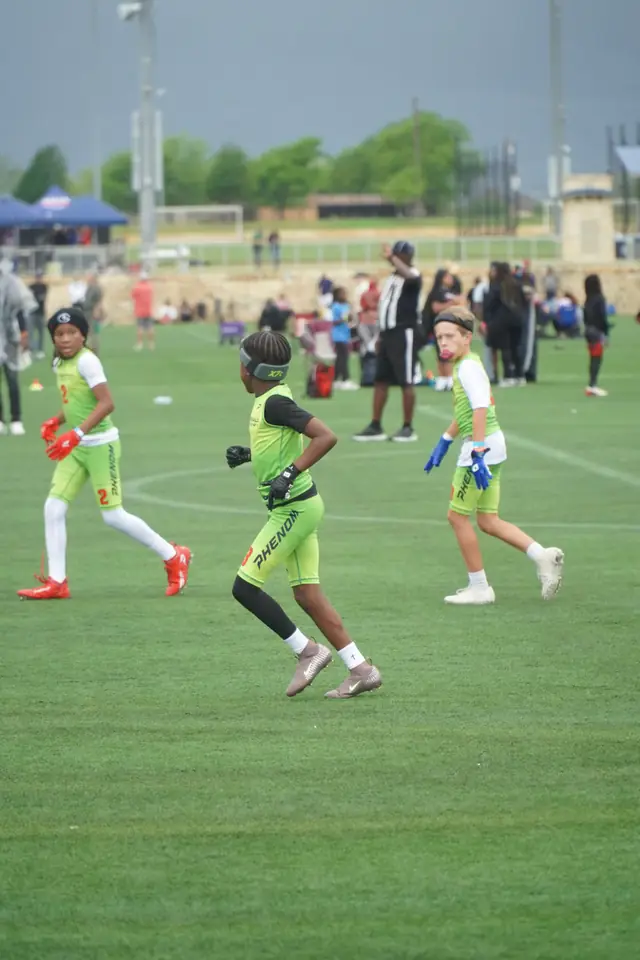
If you are looking at youth football for a five or six-year-old, the thing you actually want to know is rarely the thing you ask first. You ask about times and costs. What you are thinking about is contact.
It is worth knowing that a well-built program has already answered that for you in the way it orders its teams. At G1 Football Academy in Dallas the league ladder runs Kindergarten flag, 1st grade flag, 3rd grade tackle, 4th grade tackle. Read it slowly and you will notice two things: there are two full years of flag before contact appears at all, and there is a deliberate gap where 2nd grade would be. Neither is an accident of scheduling.
Flag is not a waiting room
The common assumption is that flag is a softer holding pattern until a child is big enough for the real thing. It is closer to the opposite. Flag is where the game itself gets taught, and it gets taught better there than it can be taught later.
Think about what a child has to learn to play football at all. Where to line up. What their assignment is on this particular play. How to read the person across from them. How to run a route, or cover one. How to find the ball in the air. Every one of those is a thinking problem, and every one of them is easier to learn when the child is not simultaneously managing the fear of being hit.
Add contact too early and you get an athlete spending most of their attention on self-protection. They learn to flinch before they learn to play. Two years of flag means that by the time contact arrives, the football is already familiar, so the only new thing is the contact.
What actually changes at tackle
Here is the part that surprises parents. When a child moves from flag to tackle, the football barely changes. Assignments, formations, routes and reads carry across almost intact. What changes is physical: pad fit, tackling and being tackled, and the conditioning that contact costs.
That narrowness is good news, because it means the transition is one skill rather than a new sport. It also means the transition is a technique problem, and technique problems have right and wrong answers. Tackling taught properly is safer than tackling learned by accident in a game, which is the real argument for learning it inside a coached program rather than in a back yard.
Five signs to read, and one to ignore
Size is the sign parents weigh most and it is the least useful one. A big eight-year-old who does not want contact will have a bad season. A smaller one who is keen and well coached will be fine. What matters more:
- They ask about it. A child who brings up tackle football themselves is telling you something a physical assessment cannot.
- They take small knocks without it ending the day. Not toughness for its own sake, just a working sense that a bump is not a catastrophe.
- They can follow a two-part instruction under mild pressure. Contact adds noise; an athlete who already needs telling twice will need telling four times.
- They finish things. Football seasons have a dull middle, and contact makes the dull middle physically harder.
- They like their coaches. This one is underrated and it is decisive, because a child will absorb correction from an adult they trust and will quietly stop listening to one they do not.
Who is teaching the contact matters more than when
If your child is going to learn to tackle, the question of who teaches it is not a detail. At G1 the coaching staff includes Ramon Broadway, a three-year starter and captain at Arkansas who went on to the NFL with the San Diego Chargers and the CFL with the Edmonton Eskimos, and Ron Brooks, a cornerback taken by the Buffalo Bills in the fourth round of the 2012 draft out of LSU who later played for the Philadelphia Eagles.
The reason that matters is not the glamour. It is that these are people who played at a level where bad technique ended careers, so they treat teaching it as a serious job rather than a box to tick before the scrimmage.
If the answer is not yet
Plenty of children finishing flag are not ready for 3rd grade tackle, and a good program will say so rather than fill a roster spot. The useful options are another flag year, position training sessions to hold technique through the gap, or 7v7, which is competitive football with no tackling in it at all and divisions at 8U, 10U, 13U and 16U.
None of those is a demotion. An athlete who arrives at contact a year later and genuinely ready is ahead of one who arrived on schedule and spent the season afraid.
The straightforward way to get an actual answer about your own child is to ask someone who will watch them. Call G1 Football Academy on (972) 269-5188 with your child's age and what they want to play, and the staff will tell you where they fit.
G1 Football Academy, (972) 269-5188
Call (972) 269-5188More articles
What 7v7 actually is, and why skill-position kids develop faster in it
Parents hear 7v7 and picture a lesser version of real football. For a skill-position athlete it is closer to concentrated practice at game speed.
How to judge a youth football coach, and what to ignore
You are not really choosing a program. You are choosing the adults who will spend two afternoons a week shaping how your child handles being corrected.