How to judge a youth football coach, and what to ignore
You are not really choosing a program. You are choosing the adults who will spend two afternoons a week shaping how your child handles being corrected.
September 21, 2026 · 3 min read
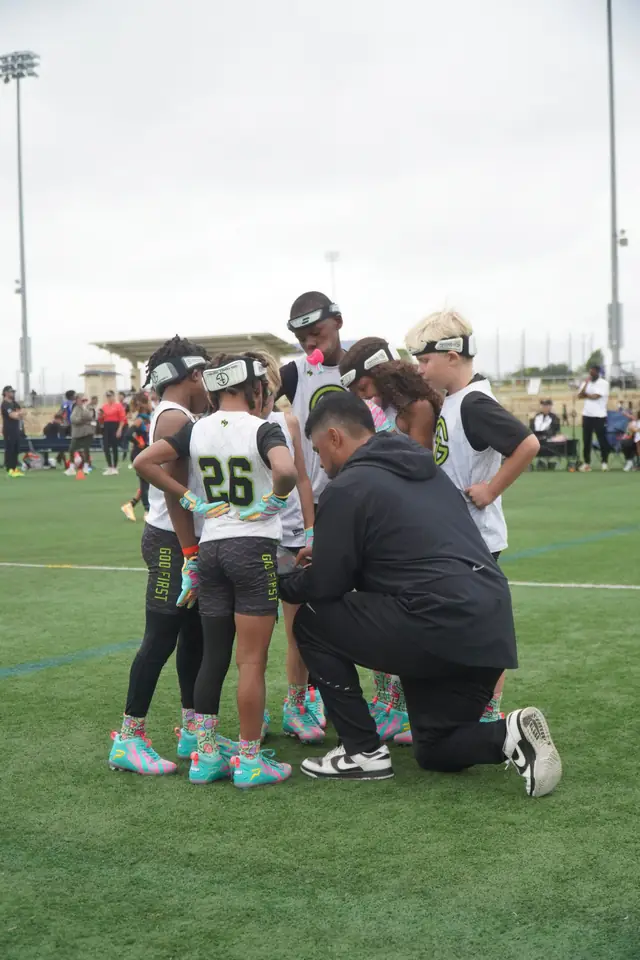
Most guidance on picking a youth sports program talks about facilities, schedules and fees. Those are the easy things to compare, which is why they get compared. The thing that will actually determine your child's season is which adults are on the field, and it is the hardest thing to evaluate from outside.
A playing resume is evidence, not an answer
A coach who played the game at a high level knows what correct looks like at speed. They have felt the difference between a release that works and one that nearly works. That is genuinely hard to get any other way, and it is why a credentialed staff is worth seeking out.
But playing and teaching are different skills. Plenty of excellent players cannot explain what they do, because they never had to think about it. So treat a resume as a strong starting point and then check the second thing: can this person teach an eight-year-old?
The test is simple. Ask a coach to explain one technique to you, an adult who does not play. If the explanation is concrete and you can picture doing it, they can teach. If it dissolves into effort words, they may be a fine player who cannot transmit it.
Ask how they correct mistakes
This is the highest-value question you can ask, and almost nobody asks it. A child will make mistakes constantly. What happens in the thirty seconds afterwards is what they will carry.
Some programs have thought about this explicitly. G1 Football Academy in Dallas names its cycle: connect, correct, reconnect. Connect with the athlete first and build trust and relationship. Correct by teaching the fix rather than criticising the error. Then reconnect, so the athlete leaves knowing the correction came from care and not control.
You do not have to adopt anyone's particular framework. The point is that a staff who can describe their approach to correction have thought about it, and a staff who look blank at the question have not. A ten-year-old who drops a pass already knows they dropped it. Whether they play freely or carefully for the rest of the season is decided by the response.
Six things worth checking
- Can they tell you who specifically coaches your child's position, by name? A vague answer about the staff usually means nobody owns it.
- Do they publish anything checkable? Rates, age divisions and staff records that can be verified are a program comfortable being looked at closely.
- What is the coach to athlete ratio at the age you care about? Twenty children and one adult is supervision, not coaching.
- Will they tell you your child is not ready for something? A program that has never turned anyone away is filling roster spots.
- What happens between seasons? A program with nothing running in the gaps loses technique every year and rebuilds it every year.
- Do the children look at the coaches when they talk? Go and watch a session. You will learn more in twenty minutes than from any brochure.
What to ignore
Ignore promises about outcomes. Any program implying it can deliver a college scholarship is either misunderstanding how recruiting works or hoping you do. Exposure can be arranged; results cannot be promised.
Ignore intensity as a proxy for quality. A coach who shouts more is not coaching harder, and volume is not information. What a child needs to hear is what to do differently and how.
Ignore trophy cabinets at young ages. A program that wins a lot at 8U may be very good, or may simply have recruited the biggest children in the area. Neither tells you whether your child will develop there.
The part nobody advertises
Ask what happens if your child stops enjoying it. The answer reveals whether the program is built around athletes or around teams. Programs that talk about supporting parents so no player gets lost, and about mentoring athletes through every stage, are describing a duty of care that extends past the useful players.
Most of your child's football career will not be the highlights. It will be the ordinary Tuesdays. Choose the adults you want on those.
If you want to see a staff record laid out rather than summarised, G1 publishes its coaching register in full, and the academy can be reached on (972) 269-5188.
G1 Football Academy, (972) 269-5188
Call (972) 269-5188More articles
Flag or tackle: how to tell when your child is ready for contact
The question underneath almost every first phone call to a youth football program is whether it is going to hurt their child. Here is the honest way to think about it.
What 7v7 actually is, and why skill-position kids develop faster in it
Parents hear 7v7 and picture a lesser version of real football. For a skill-position athlete it is closer to concentrated practice at game speed.